Repair or Replace Your AC: An Alhambra Guide
The quick read: Alhambra Trane HVAC settles whether to repair or replace a Trane AC across Alhambra, CA, from the 91801 Emery Park core to the 91803 line. To get the 50 percent and age-times-cost rules run with real numbers on your aging unit, with no pressure to replace, call (213) 566-7218 or book online.
Quick numbers
- The 50 percent rule: when repair > half of replacement and age is past 10-12 years, replace.
- The $5,000 rule: age times repair cost above $5,000 tips the call toward replace.
- Capacitor or contactor $150-$450; compressor $1,200-$3,500.
- Refrigerant leak repair $225-$1,500; central AC replacement $5,000-$12,000.
- Typical Trane lifespan here: 12-18 years with maintenance.
- A new system carries a fresh 10-year parts warranty; a repair does not.
- Independent advice; we are not paid to push a replacement.
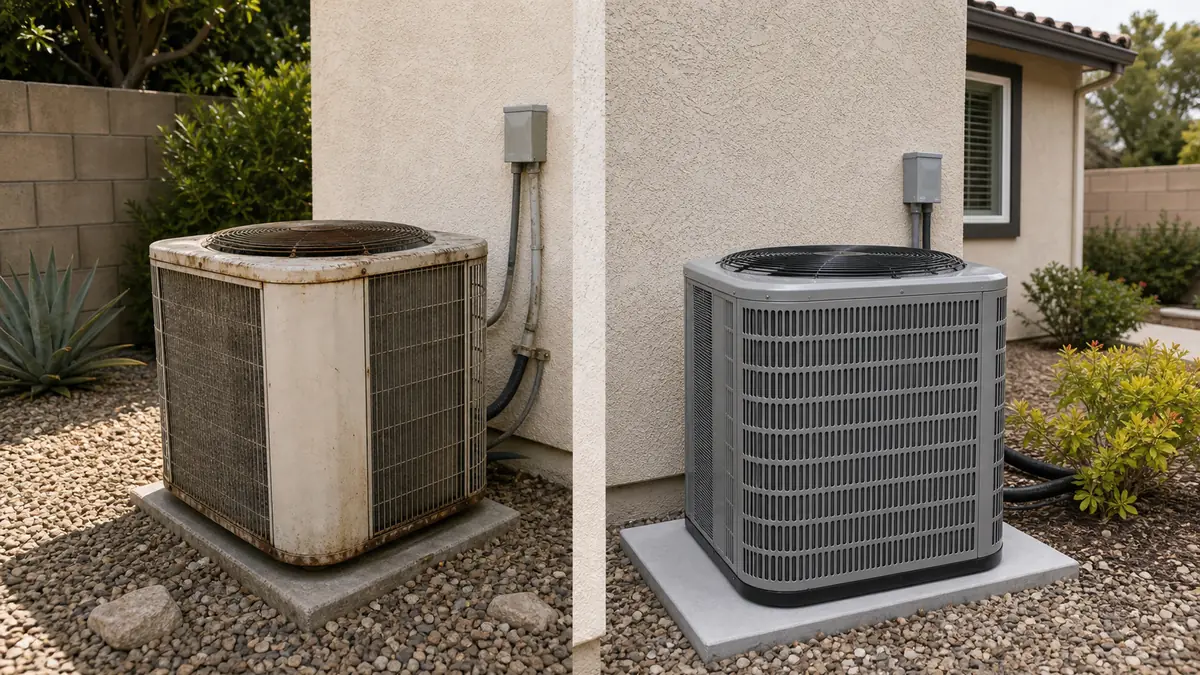
How do the two decision rules work?
Nearly every repair-or-replace call rests on two plain rules of thumb that we run with real figures rather than sales pressure. Take the 50 percent rule first: once a repair would cost more than about half of what a comparable new system runs, and the unit is already beyond 10 to 12 years, replacing tends to win, since otherwise you are pouring half a new-system price into worn-out equipment. The second is the age-times-cost rule: take the unit's age in years, multiply by the repair cost in dollars, and when that product passes about $5,000, the scale tips toward replacing. A 13-year-old unit facing a $400 repair works out to $5,200, close enough to deserve a hard look; the identical repair on a 4-year-old unit is a clear fix.
These are guides, not laws. A 2009 XR13 facing a $2,500 compressor is a clear replace; a 2019 XV18 needing a $350 capacitor is a clear repair. The judgment lives in the gray middle, and that is where an honest, independent opinion matters, because we are not paid to sell you a system.
| Unit age | Typical repair band | Replace band | Lean toward |
|---|---|---|---|
| 0-8 years | $150-$1,500 | $5,000-$12,000 | Repair |
| 9-12 years | $400-$2,000 | $5,000-$12,000 | Depends; apply both rules |
| 13-16 years | $1,200-$3,500 | $5,000-$12,000 | Often replace |
| 17+ years | any major part | $5,000-$12,000 | Replace and right-size |
Which repairs are almost always worth it?
Some failures are cheap and stocked, so repairing makes sense at almost any age short of a unit that is rusting apart. On a Trane condenser, the dual-run capacitor is the top example: our Zone 9 heat cooks it first, and replacing it runs $150 to $450. Contactors are similar. A condenser fan motor at $300 to $700 is usually worth it. Even a single, well-located refrigerant leak repaired properly, with the joint fixed and a correct charge weighed in, is reasonable on a sound system. The line moves when the repair touches the compressor or recurs.
Which failures push toward replacement?
A compressor failure is the classic tipping point. Replacing a Climatuff compressor costs $1,200 to $3,500, and on a unit of 13 years or more that one repair frequently trips the 50 percent rule on its own. Recurring refrigerant leaks are another: a system you top off every summer has a leak that will keep finding new joints, and chasing it on old equipment is throwing money away. A cracked furnace heat exchanger is a safety stop, full replacement of that furnace, no debate. And any major repair on a 17-plus-year unit is the moment to right-size a new system instead.
How does Alhambra's housing change the math?
Alhambra's wall-to-wall 1920s and 1930s stock adds a wrinkle the rules alone miss. Many of these homes carry oversized central units installed by square-foot guesses, or central systems forced into homes that never had a good duct path. When such a system fails, replacing it like-for-like repeats the original mistake. Replacement here is often the opening to right-size the load with a Manual J calculation, or to move a duct-starved Emery Park or Mayfair bungalow onto a ductless system that genuinely fits. So the decision is not just repair-or-replace; it is repair, replace, or rethink the whole approach. The sizing guide covers that rethink.
What about efficiency and rebates?
Swapping in a new system can trim running cost, but read the old bill before you spend; a dirty coil or leaky ducts bleed energy on any unit and cost little to put right. If the equipment really is old, a current 14.3 SEER2-or-better system cuts cooling cost by a real margin in our heat. Converting to a heat pump can retire an aging furnace and AC in one move and may pick up LADWP, SCE, or TECH Clean California money, though that funding moves in rounds and several pots were posted as reserved early in 2026. Keep in mind that the federal 25C tax credit ended as of December 31, 2025, which leaves 2026 installs with nothing to claim. Confirm where any rebate stands today; the full picture is in the SEER2 and rebates guide.
Worked examples: running the two rules on real Trane units
Numbers settle this faster than opinions, so here are four worked cases drawn from the kind of Trane equipment we see across Alhambra. Each one runs both rules side by side. The 50 percent rule compares the repair to a comparable central AC replacement, which lands between $5,000 and $12,000 here, so use about $7,000 as a mid-point for a typical right-sized job. The age-times-cost rule multiplies the unit's age in years by the repair dollar figure and flags anything over roughly $5,000.
| Unit and age | Repair quoted | Age x cost | Vs 50% of ~$7,000 | Verdict |
|---|---|---|---|---|
| 2019 XV18, 7 yr | $350 capacitor | $2,450 | Far below $3,500 | Repair, clearly |
| 2014 XR16, 12 yr | $900 TXV + charge | $10,800 | Below $3,500 | Repair, but watch it |
| 2011 XR14, 15 yr | $1,500 coil leak | $22,500 | Below $3,500 | Replace, age rule clears |
| 2010 XR13, 16 yr | $2,800 Climatuff compressor | $44,800 | Above $3,500 | Replace, both rules clear |
Notice the second row: a $900 repair on a 12-year XR16 passes the 50 percent test on its own, yet the age-times-cost rule already reads $10,800 and the unit is near the end of a Zone 9 service life. That is the gray middle where the two rules disagree, and where we lay both numbers on the table and let you weigh a one-time fix against the odds of the next failure landing during an August heat wave. The third and fourth rows are not close: a coil leak or a compressor on a 15-to-16-year unit is a replace in nearly every case, and the only real question becomes which replacement is right-sized for the home.
Does converting to a heat pump change the replace math?
It can, and it is worth a separate look when an aging AC and an aging gas furnace are both on the bubble. Replacing a dead AC alone runs $5,000 to $12,000; replacing a dead furnace alone runs $3,000 to $7,500. If both are 15-plus years old, a single heat-pump conversion at $6,000 to $16,000 retires both in one job and one permit rather than two separate visits, and a Trane 4TWV0-series variable-speed heat pump handles both cooling and the mild Zone 9 heating load. The trade-off is the higher single-ticket cost and the electrical and panel work an all-electric conversion sometimes needs. Utility programs from LADWP, SCE, and TECH Clean California have at times offset a meaningful slice of that, though several funds were posted as reserved or waitlisted in early 2026 and the federal 25C credit ended December 31, 2025, so confirm current standing before counting on any of it. We run the conversion math against a like-for-like AC-plus-furnace replacement so the decision is grounded in your real numbers; the details are in the SEER2 and rebates guide and the heat pump page.
A diagnostic case scenario (illustrative)
Consider a fictional but typical Emery Park bungalow with a 2010 Trane XR13. The homeowner calls because it hums but will not cool on a 96 F August afternoon. We find a failed capacitor, a $300 fix, but also a slow leak at the Spine Fin coil that would run $900 to repair, and a coil too corroded to last. The unit is 16 years old. Capacitor by itself: repair. Capacitor plus the leak plus a tired coil on a 16-year unit: age times cost sails past $5,000, and the bundled repair runs to more than half a replacement. We would lay out both numbers and let the owner choose, leaning replace, ideally right-sized for the actual load. This scenario is illustrative, not a specific customer.
The bottom line for an Alhambra Trane owner
When a Trane in an Alhambra home acts up, run both rules before spending. Repair without hesitation when the unit is under about 10 years and the fault is a capacitor, contactor, or fan motor; those parts are cheap, stocked, and worth fixing at almost any age. Lean replace when a compressor, a recurring refrigerant leak, or a cracked heat exchanger lands on a unit past 12 to 15 years, or when age times the repair cost clears roughly $5,000, or when the repair tops half of a comparable replacement. Treat a 17-plus-year unit facing any major part as a replace-and-right-size moment, and use a failing AC-and-furnace pair as the prompt to weigh a single heat-pump conversion. Above all, replace for a real, measured reason, never a sales pitch, and let an independent opinion rather than a commission make the call.
Common questions
What is the 50 percent rule for AC replacement?
When a repair would run past roughly half the cost of a comparable new system on a unit already older than 10 to 12 years, replacing usually comes out ahead. Put a $2,500 compressor on a 13-year-old XR13 that costs maybe $4,500 to swap out and the repair clears that mark; a $350 capacitor on the same machine does not come close.
How long does a Trane AC last in Alhambra?
A well-maintained Trane commonly runs 12 to 18 years here, but Zone 9 heat and street dust shorten that without coil cleaning and charge checks. By year 15, even a working unit is a candidate to plan a replacement around, rather than waiting for a peak-heat failure.
Is it worth replacing just the outdoor condenser?
Rarely a good idea alone. Mixing a new condenser with an old indoor coil risks a refrigerant or efficiency mismatch and can void warranty coverage. We replace the condenser and coil as a matched set so the system performs and the warranty holds.
Does a repair reset my Trane warranty?
It does not. Fixing a unit gets it running again but adds nothing to the original 10-year parts warranty. A fresh warranty rides only with a new system, and only when the installer registers it inside 60 days. That gap is one more figure that belongs in the replace-versus-repair math on an aging unit.
Should I replace a working AC just to save energy?
Only after checking why it costs what it does. A dirty coil, low charge, or leaky ducts waste energy on any unit and are cheap to fix. If the system is genuinely old and inefficient, a current SEER2 unit will lower cooling cost, but replace for a real reason, not a sales pitch.
Last updated 2026-06-13. Cost ranges are typical 2026 SoCal figures and change; confirm with a local quote.
Related: HVAC sizing and Manual J, SEER2 and rebates, AC installation, and AC repair.