Trane Furnace 4 Flashes in Alhambra: Open High Limit
The quick read: A Trane furnace flashing 4 times in Alhambra, CA (ZIP 91801) is an open high-temperature limit, meaning the unit overheated from restricted airflow and shut off on its safety. Replace the filter and clear the returns, then call (213) 566-7218 or book online and we confirm the cause.
Quick numbers
- Code: 4 LED flashes on the integrated furnace control.
- Meaning: open high-temperature limit, an airflow fault.
- Most common cause: clogged 1-inch filter or blocked return.
- Airflow repair: about $150 to $600.
- High-limit switch: roughly $150 to $350 installed.
- Diagnostic visit $89 to $200, often credited toward an approved repair.
- Service area: Alhambra, Emery Park, Bean Tract, Midwick (91801, 91803).
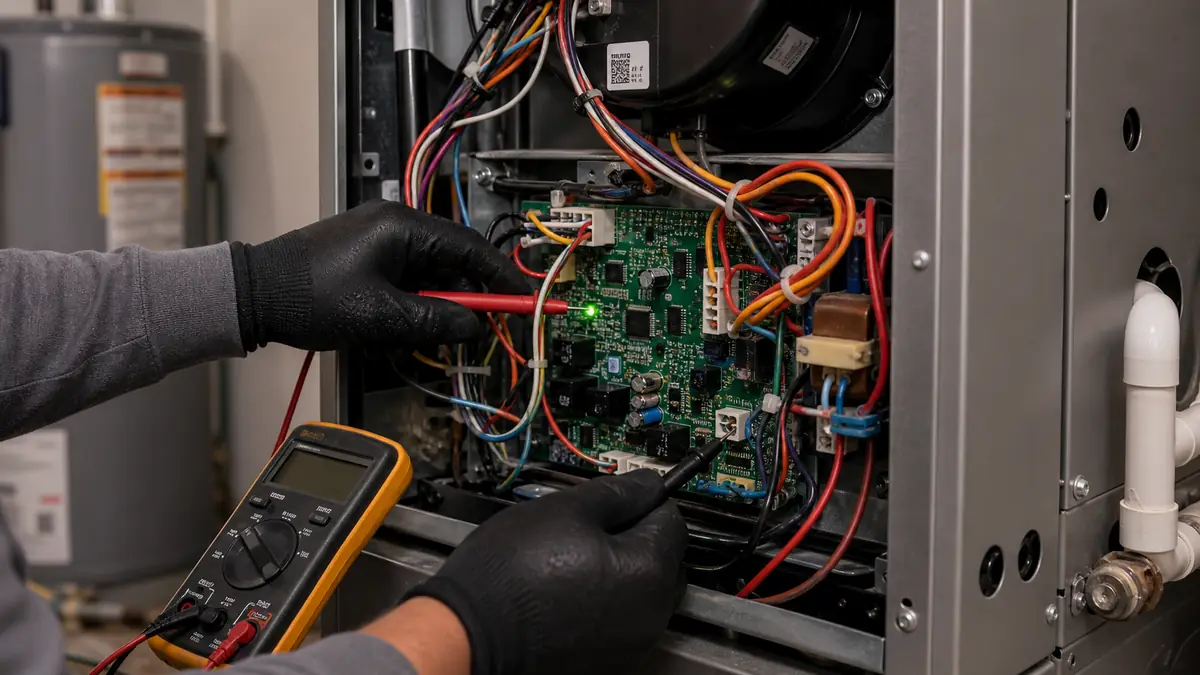
What does a Trane furnace 4-flash code mean?
On a Trane gas furnace, the integrated furnace control flashes a status LED you read through the small window on the lower door. Four flashes, then a pause, then four again, is the open high-temperature limit code. In plain terms, the furnace produced more heat than the airflow could carry away, the air around the heat exchanger climbed past the limit switch setpoint, and that switch opened to cut the burners. The control logs it as a fault and keeps the blower running to purge the heat. This is the safety doing exactly what it was designed to do, which is why a 4-flash code should be read as a restricted-airflow message, not as a broken furnace. The components involved are the air filter, the blower wheel and its ECM or PSC motor, the high-limit switch itself, and the duct system that ties them together. Nearly every 4-flash call comes down to one of those four, and the order we check them in is set by which fails most often in this part of the San Gabriel Valley.
Why does my Trane furnace overheat in Alhambra homes?
Alhambra's housing stock pushes airflow problems to the front of the line. A large share of homes here are 1920s Spanish Colonial revival, Tudor revival, Craftsman, and storybook cottages, plus the Colonial-revival tracts around Orange Blossom Manor. Many were never built for forced-air heat, so the ductwork was threaded into shallow attics and tight wall chases decades later, often undersized and full of sharp turns. That high static pressure starves the heat exchanger of the airflow it needs, and the limit trips. Add a homeowner who closes registers in unused bedrooms in Emery Park or Midwick, a return grille tucked behind a sofa, or a 1-inch filter left in past its month during our Zone 9 heat-island fall, and the furnace tips over the limit on the first cold snap. The valley heat-island effect also means many of these furnaces sit in 110-degree summer attics, which bakes filters and motors and leaves them marginal by heating season. None of that is exotic. It is the predictable result of modern equipment moving air through old bones.
How do you diagnose a 4-flash high-limit fault?
We work the airflow path from the easy end to the buried end, with instruments rather than guesses. First we confirm the code by counting flashes and reading any stored history on the board. Then we measure, because a number tells us where the restriction lives.
| Step | Instrument / check | Reading that points to the fault |
|---|---|---|
| Filter and returns | Visual, airflow by hand | Gray, collapsed, or oversized filter; blocked return |
| Temperature rise | Two thermometers, supply and return | Rise above the data-plate range (often 40-70 F) |
| Static pressure | Manometer across the air handler | Total external static over about 0.5 in. w.c. |
| Blower | Amp clamp, visual on the wheel | Low CFM, caked wheel, weak ECM, slipping belt on older units |
| Limit switch | Ohmmeter, manufacturer spec | Opens early or stays open cold = failed switch |
A high temperature rise with high static pressure tells us the duct or filter is choking the system. A normal static with a weak blower points at the motor or a dirty wheel. And if airflow measures fine but the limit still opens, the switch itself has drifted and gets replaced. We do not swap the limit switch first; on a Trane furnace that almost always masks a duct problem that will crack the heat exchanger later.
What can I safely check before calling a pro?
There is a real homeowner checklist here, and it solves a fair number of these calls outright. With the furnace off, pull the filter and hold it to a light; if you cannot see through it, replace it with the same size and a moderate MERV, not the densest filter on the shelf, since an over-restrictive filter causes the very 4-flash code you are chasing. Walk the house and open every supply register, then make sure the return grille is clear of furniture, drapes, and rugs. Confirm the furnace closet door or panel is fully seated, because many Trane units will not run safely with the door interlock open. After that, cycle the thermostat and watch one full heat cycle. If it completes without re-flashing, the airflow was the culprit. Stop at anything past airflow. Do not open the burner compartment, do not jumper the limit switch to force a run, and do not keep resetting a furnace that re-locks, because each overheating cycle stresses the heat exchanger that separates combustion gases from the air you breathe. When 4 flashes returns after a clean filter and open registers, that is the moment to book the visit.
What does fixing a Trane 4-flash code cost here?
The price follows the part the diagnosis lands on, not the code. Most 4-flash calls in Alhambra resolve on the cheap end because they are airflow, and the airflow fixes range from a filter to a duct correction. A drifted limit switch sits in its own narrow band. The lane below assumes a confirmed diagnosis; the diagnostic fee is typically credited toward an approved repair.
| What the diagnosis finds | Repair | Cost lane |
|---|---|---|
| Clogged or wrong filter | Correct filter and reset | Within a $89-$200 visit |
| Dirty blower wheel | Pull and clean the blower | $150-$400 |
| Restricted or closed duct | Open dampers, correct a duct run | $200-$600 |
| Weak ECM blower motor | Blower motor or module | $450-$2,300 |
| Failed high-limit switch | Replace the limit switch | $150-$350 |
When is a 4-flash code urgent?
A single 4-flash event that clears after a new filter is routine, not an emergency. It becomes urgent when the furnace short-cycles, lighting and dropping out every few minutes, or when 4 flashes returns immediately after a reset, because that pattern means the heat exchanger is repeatedly overheating. Combine that with a hot, plastic-burning smell, soot at a register, or a yellow rather than crisp blue flame, and you should shut the furnace off at the thermostat and call. Those signs raise the possibility of a cracked heat exchanger, which is a combustion-safety issue, not just a comfort one. In an older Alhambra home with a furnace tucked into a closet or attic near sleeping areas, that is worth treating seriously. We carry a combustion analyzer and check for a crack whenever the overheating history warrants it, rather than just clearing the code and leaving.
Common questions
What does 4 flashes mean on a Trane furnace?
Four flashes is an open high-temperature limit. The furnace ran too hot, and the high-limit switch opened to shut off the burners as a safety. The fault is real, not nuisance: it almost always traces to restricted airflow, most often a clogged filter, a blocked return, or an undersized retrofit duct in an older Alhambra home.
Can I clear a 4-flash code myself?
Yes, the homeowner part is safe. Replace a dirty filter, open every supply register, and confirm the return grille is not blocked by furniture or a rug. Then cycle the thermostat. If the furnace runs a full cycle without re-flashing, you fixed it. If 4 flashes returns, the airflow restriction is deeper and the limit switch itself may be weak, so book a diagnostic.
Is a Trane 4-flash code dangerous?
The code itself is the safety working correctly; the open limit stopped the furnace before the heat exchanger overheated. The danger is in defeating it. Repeated overheating cycles can crack a heat exchanger, and a cracked exchanger can vent combustion byproducts indoors. Do not jumper or bypass a limit switch. Clear the airflow cause or have it diagnosed.
How much does a Trane 4-flash repair cost in Alhambra?
An airflow repair runs about $150 to $600, depending on whether it is a filter, a duct correction, or a blower cleaning. A failed high-limit switch is roughly $150 to $350 installed. The $89 to $200 diagnostic is often credited toward an approved repair, and we quote a flat price before any work starts.
Related: Trane fault codes, Trane 8 flashes, Trane gas furnaces, and AC repair.