Trane Gas Furnaces in Alhambra
The quick read: Alhambra Trane HVAC repairs and replaces Trane gas furnaces across Alhambra, CA and the 91801 ZIP, reading the control-board LED flash codes on everything from the 80% XR80 to the modulating XC95m. Call (213) 566-7218 or book online; an igniter or flame-sensor fix runs $150 to $450, and a full furnace replacement runs $3,000 to $7,500.
Quick numbers
- Models served: XR80, XL80, XV80, S9X1, XR95, S9X2, S9V2, XV95, XC95m.
- Igniter or flame sensor repair: typical $150-$450.
- Pressure switch or inducer motor $200-$700; control board $300-$900.
- ECM blower motor $450-$2,300; full furnace replacement $3,000-$7,500.
- 80% AFUE (XR80) is often adequate for mild Zone 9 winters.
- Service area: Alhambra, Granada Park, Orange Blossom Manor, Mayfair (91801, 91803).
- Independent; in-warranty parts referred to the installing dealer first.
Which Trane furnace makes sense in Alhambra?
Heating is the lighter load here. Alhambra's mild Zone 9 winters mean an 80% AFUE furnace such as the Trane XR80, XL80, or XV80 is frequently the right call: lower install cost, no condensate or special venting, and adequate output for a home that runs heat only a few weeks a year. The condensing tier, from the value S9X1 and XR95 up to the two-stage S9V2 and the modulating XC95m at roughly 97% AFUE, makes sense for a larger or drafty older home or a homeowner who wants the efficiency, but it is rarely a necessity here.
| Flashes | Meaning | First check |
|---|---|---|
| 2 | System lockout (ignition retries exceeded) | Igniter, flame sensor, gas supply |
| 3 | Vent/pressure switch error | Inducer, blocked flue, switch |
| 4 | Open high-temperature limit | Dirty filter, blocked coil, low airflow |
| 7 | Gas valve circuit error | Gas valve and wiring |
| 8 | Low flame-sense signal | Clean or replace flame sensor |
| 9 | Igniter circuit / polarity issue | Hot-surface igniter, line polarity |
Which Trane furnace model do I have, and what is it for?
The Trane furnace lineup is sorted by efficiency (AFUE) and by how the gas valve and blower stage. For mild Alhambra, the 80% tier covers most homes, but here is the full range we service:
- XR80 / XL80 / XV80 (80% AFUE). Single-stage non-condensing furnaces, the budget tier and frequently the right call in Zone 9 where heat runs only a few weeks a year. No condensate drain or special venting.
- S9X1 / XR95 (95-96% AFUE). Single-stage condensing value furnaces for homeowners who want the efficiency bump without two-stage hardware.
- S9X2 / S9V2 (96% AFUE). Two-stage furnaces; the S9V2 adds a variable-speed ECM blower for quieter, steadier heat and better summer airflow when paired with an AC.
- XV95 / XC95m (97% AFUE). The flagship tier; the XC95m modulates its gas valve and runs a variable-speed ECM for the smoothest output, sensible for a larger or draftier older home or a homeowner who simply wants top efficiency.
The model is on the rating plate inside the blower door. Higher tiers add cost and condensate plumbing, so we match the furnace to how much you actually heat rather than defaulting to the priciest box.
How do you diagnose a no-heat Trane furnace?
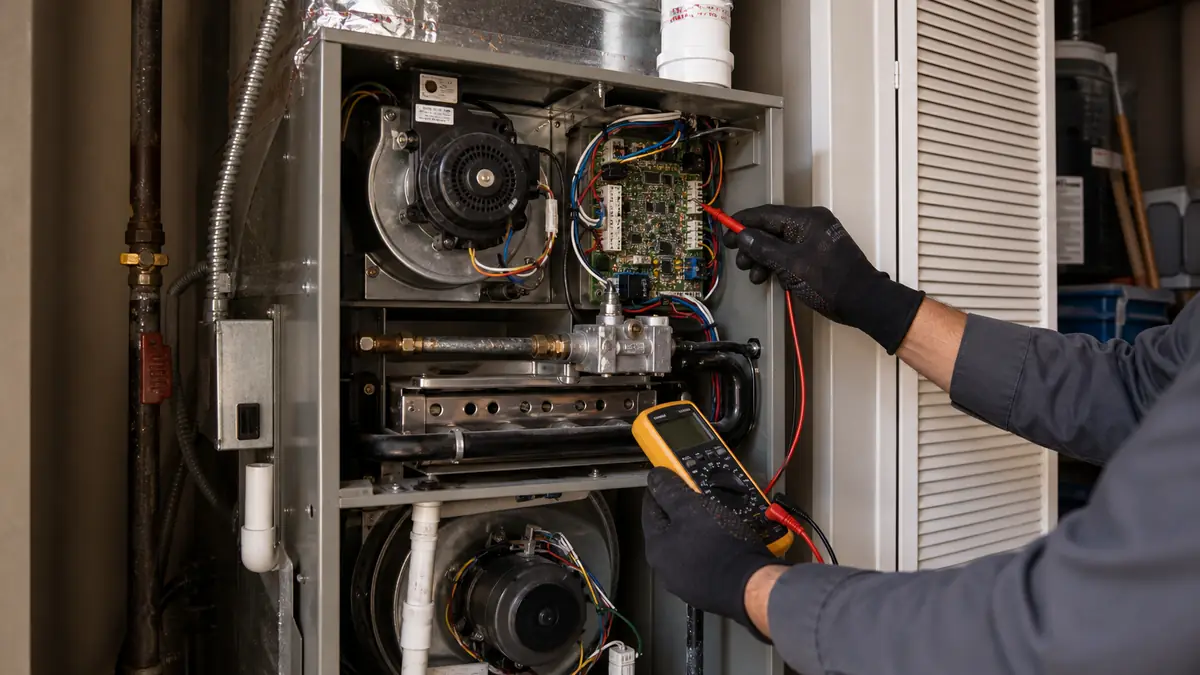
We start at the control board's status LED and count the flash pattern, because Trane furnaces report faults that way rather than with a screen. A continuous-on LED means the board itself failed; continuous-off means no power. From the code we test the named component: a hot-surface igniter for resistance, a flame sensor for microamp signal, the pressure switch and inducer for a complete vent path, and the high-limit for nuisance trips caused by a dirty filter. Communicating systems on an XL824 or XL850 also show plain-language alerts.
What are the most common furnace repairs here?
Two stand out. A dirty flame sensor (8 flashes) lets the burner light but not stay lit, so the furnace short-cycles; cleaning or replacing the sensor is a quick fix. An open high-limit (4 flashes) usually traces to a clogged filter or restricted airflow, which in Alhambra's old homes often means a collapsed or undersized retrofit duct, not a furnace fault at all. Igniters, pressure switches, and ECM blower motors round out the list. We fix the cause, not just the symptom.
Installing or replacing a furnace in an Alhambra home
Furnace replacements here run into the same old-house constraints as cooling work. Many 1920s and 1930s homes have the furnace in a hall closet or a cramped attic or basement, so swapping an 80% unit for a 95-plus percent condensing furnace means adding a condensate drain and changing the venting to PVC, which is not always easy to route in a finished older home. That is one practical reason the 80% XR80 stays popular locally. California's Ultra-Low NOx emissions rules apply to gas furnaces in this region, so a replacement must meet the current NOx standard. We also measure static pressure on the existing ducts, because the kinked retrofit runs common in Emery Park and Mayfair will trip a new furnace's high-limit (the 4-flash code) just as they choke an AC.
80 percent versus condensing: which furnace here?
This is the core furnace decision in a mild climate, and the answer leans toward the simpler unit more often than colder regions.
| Factor | 80% AFUE (XR80/XL80) | Condensing 95-97% (S9V2/XC95m) |
|---|---|---|
| Install cost | Lower; no condensate or PVC venting | Higher; needs a drain and PVC flue |
| Fuel savings here | Modest heating load limits the payback | Real, but slow to recoup in Zone 9 |
| Comfort | Single-stage on/off heat | Two-stage or modulating, steadier, quieter |
| Best for | Most Alhambra homes, light heating use | Larger or drafty homes, efficiency-minded owners |
When is furnace replacement the better move?
A cracked or rust-perforated heat exchanger is a safety stop; that furnace is done. Beyond that, if the unit is 15-plus years old and facing a major repair, replacement usually wins, and it is the moment to decide between a like-for-like furnace and a heat-pump conversion that also handles cooling. We lay out both paths honestly, with the cost math in the repair-or-replace guide and the conversion case on the heat pump page.
Common questions
Do I need a high-efficiency furnace in mild Alhambra?
Often not. Heating demand in Zone 9 is low, so an 80% AFUE furnace like the Trane XR80 is frequently adequate and far cheaper to install than a 95-plus percent condensing unit. We will not upsell a modulating XC95m for a house that runs the heat a few weeks a year unless you specifically want it.
What does a flashing light on my Trane furnace mean?
The integrated furnace control flashes a status LED. Two flashes is a system lockout, three is a pressure-switch or inducer fault, four is an open high-limit from low airflow, eight is weak flame sense from a dirty sensor, and nine is an igniter circuit problem. We count the flashes, then test the named part.
Why does my furnace start then shut off after a minute?
That short-cycle pattern often means a dirty flame sensor (LED 8 flashes): the burner lights, the board cannot prove flame, and it shuts down for safety. A clogged filter tripping the high-limit (4 flashes) does the same. Both are common, inexpensive fixes once we read the code.
Should I keep the furnace or convert to a heat pump?
If your furnace is sound and your AC is fine, keep it. If both are aging, a heat pump can replace them with one electric system, and Alhambra's mild winters make that practical. We give you the honest comparison rather than steering you toward whichever job is bigger.
How do I know if my furnace heat exchanger is cracked?
Warning signs include a rollout-related lockout, soot near the burners, a flame that rolls or changes color when the blower starts, and in some cases a faint odor. A cracked or rust-perforated heat exchanger is a carbon-monoxide safety stop, so we inspect it directly with a camera and combustion analysis. If it is cracked, that furnace is done and replacement is the only safe path, not a patch.
Why does my Trane furnace blow cold air sometimes?
A short burst of cool air at startup is normal while the heat exchanger warms. Sustained cold air usually means the burner is not staying lit, often a dirty flame sensor that throws the 8-flash code, or the high-limit tripped on low airflow (4 flashes) and only the blower is running. We read the LED code and test the named part rather than guessing.
Related: Trane heat pumps, Trane fault and flash codes, maintenance plans, and ComfortLink controls.