Trane Furnace 8 Flashes in Alhambra: Weak Flame Sense
The quick read: A Trane furnace flashing 8 times in Alhambra, CA (ZIP 91801) is a low flame-sense signal, meaning the flame sensor reads too little microamp current and the control distrusts the flame. Call (213) 566-7218 or book online and we clean or test the sensor and verify the reading.
Quick numbers
- Code: 8 LED flashes on the integrated furnace control.
- Meaning: low flame-sense signal, weak microamp current.
- Most common cause: a flame sensor coated in oxide or silica.
- Healthy reading: about 4 to 6 microamps; trouble below 1 to 2.
- Flame-sensor clean or replace: about $150 to $350.
- Diagnostic visit $89 to $200, often credited toward the repair.
- Service area: Alhambra, Alhambra Vista, Granada Park, Midwick (91801, 91803).
What does a Trane furnace 8-flash code mean?
Eight flashes on the Trane integrated furnace control is the low flame-sense signal. To understand it you need to know how the furnace proves a flame. After the igniter lights the burners, a thin metal rod sitting in the flame, the flame sensor, passes a tiny direct current to ground through the ionized gases of the burning flame. The control reads that current in microamps. A healthy flame typically returns 4 to 6 microamps. When the rod gets coated with oxide, silica, or carbon, that coating insulates it, the current drops toward 1 microamp or less, and the control concludes it cannot reliably prove the flame is lit. Rather than risk pumping gas with no confirmed flame, it flags 8 flashes and, as the signal worsens, shuts the gas valve. So the components in play are narrow: the flame sensor rod, its wire and connector, the burner ground, and the control board that reads the current. The 8-flash code is the furnace telling you it can light, but it can no longer trust what it sees.
Why does flame sense fail on Alhambra furnaces?
Two local factors push these sensors to fail. The first is simple age and duty. Many furnaces in Emery Park, Bean Tract, and the Orange Blossom Manor tracts are decades old, and the flame sensor is a wear item that slowly accumulates a film every heating season. In a long-serving Alhambra furnace that has never been cleaned, the rod is often the first thing to cross the threshold. The second factor is environmental. The western San Gabriel Valley sits in a heat-island pocket east of downtown LA with dusty, dry inland summers, and that fine grit and any silica from dust or certain cleaning aerosols bakes onto the hot sensor rod and forms an insulating glaze faster than it would in a coastal climate. Homes that run the furnace closet as a catch-all storage space, common in smaller Craftsman and cottage floor plans here, pull more dust and lint across the burners. None of these are equipment defects. They are the ordinary reasons a flame sensor in this valley drifts low and trips 8 flashes, usually after the first hard run of the season.
How do you diagnose a low flame-sense signal?
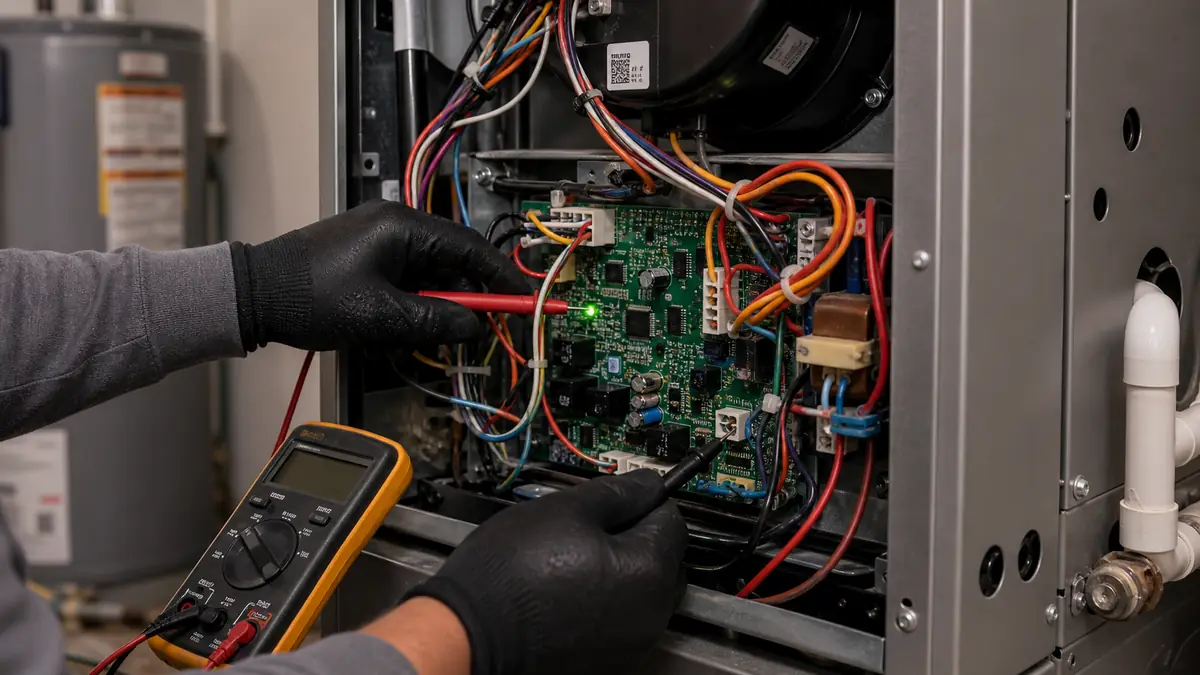
This diagnosis lives on a meter, because flame sense is a number. We put a microamp meter in series with the sensor and watch what the flame actually returns, then decide whether to clean, rewire, or replace.
- Read the live signal. A multimeter set to DC microamps, placed in series with the flame-sense wire, shows the real current while the burners run. Under 2 microamps with an 8-flash history confirms the fault.
- Clean and re-read. We gently clean the rod with fine abrasive, never sandpaper that leaves grit, and re-measure. A jump back to 4 to 6 microamps means the coating was the problem and the repair is done.
- Check the ground. Flame sense needs a solid burner-to-chassis ground. A loose ground screw or corroded connection drops the signal even with a clean rod, so we verify it with the meter.
- Inspect wire and connector. A cracked ceramic insulator, a frayed sensor wire, or a loose spade terminal leaks current to ground and mimics a dirty sensor. We replace a damaged sensor outright rather than nurse it.
- Confirm a full cycle. We watch the furnace light, prove flame, and run a complete cycle without dropping out before we call it fixed.
If a cleaned, well-grounded, properly wired sensor still reads low, the rod is spent and we install a new one. Only when a known-good sensor reads correctly but the board still flags 8 flashes do we suspect the control itself, which is rare on this code.
What can a homeowner safely do here?
Honestly, the safe homeowner list for 8 flashes is short, and that is the right answer rather than a sales pitch. You can replace the air filter and confirm the furnace door panel is fully seated, since a clean intake and a closed door support steady combustion. You can also note the pattern, whether the furnace lights and drops out or never lights, because that detail speeds the diagnosis. What we do not recommend is opening the burner compartment to clean the flame sensor yourself. That means working inside a live gas appliance, and without a microamp meter you cannot tell whether your cleaning actually restored the signal or whether the real fault is the ground or the wire. A flame-sensor service is one of the quickest, lowest-cost visits we run, so the time-and-risk math favors a pro for this specific code. If your furnace is short-cycling on heat, leave it off and book rather than resetting it repeatedly.
What does an 8-flash repair cost in Alhambra?
This is one of the friendlier codes on the cost ladder. The overwhelming majority of 8-flash calls resolve with a flame-sensor clean and a verified microamp reading, which sits at the low end. The price climbs only if the rod is worn out and needs replacing, or if the ground, wire, or board is implicated. The lane below assumes a confirmed diagnosis, and the diagnostic fee is typically credited toward the repair.
| What the diagnosis finds | Repair | Cost lane |
|---|---|---|
| Coated flame sensor | Clean rod, verify microamps | $150-$250 |
| Worn-out sensor rod | Replace the flame sensor | $200-$350 |
| Loose or corroded ground | Repair burner ground | Within a $89-$200 visit |
| Damaged sensor wire/connector | Replace wire and terminal | $120-$300 |
| Control board (rare) | Replace integrated furnace control | $400-$900 |
When should I treat 8 flashes as urgent?
A low flame-sense signal is rarely a same-night safety emergency the way a gas leak or a cracked heat exchanger is, but it should not be ignored either. The practical urgency is comfort and reliability: a furnace that drops out mid-cycle on a cold Alhambra night will leave you without heat, and the sensor only gets worse, ending in a hard lockout. Treat it as more pressing if the 8-flash code arrives with a gas smell, repeated hard lockouts, or a furnace that will not relight at all, because those can point past the sensor toward a gas-supply or valve issue that is a pro call. For a furnace that simply short-cycles on heat, stop resetting it, leave it off to avoid stressing the ignition components, and book a flame-sense service. It is a quick fix done right, and a frustrating one if it is repeatedly reset and left to degrade.
Common questions
What does 8 flashes mean on a Trane furnace?
Eight flashes is a low flame-sense signal. The flame sensor is reading too little flame current, so the control doubts a flame is present and starts to question every cycle. The furnace may still light but drop out part-way through, or it may run on the ragged edge. The usual cause is a flame sensor coated in oxide or silica, not a failed part.
Will a Trane 8-flash code stop my heat?
Often, yes, but intermittently. A low flame-sense signal lets the furnace light, then the control loses confidence in the flame and shuts the gas valve to be safe. You get heat for a few minutes, then cold air, then another try. As the sensor degrades further the furnace eventually locks out entirely. That on-again, off-again pattern is the giveaway for a flame-sense problem rather than an ignition failure.
Can I clean a Trane flame sensor myself?
It is possible but we do not recommend it for most homeowners, because it means opening the burner compartment on a live gas appliance. The sensor is a thin metal rod beside the burners that needs gentle cleaning with fine abrasive, then a microamp check to confirm the reading recovered. Without a meter you are guessing. A flame-sensor clean is a quick, low-cost pro visit and the safer choice.
How much does a Trane 8-flash repair cost in Alhambra?
A flame-sensor clean or replacement runs about $150 to $350, and most 8-flash calls land at the lower end because the rod just needs cleaning and a new microamp reading. If the sensor wiring, ground, or control board is involved, the cost rises. The $89 to $200 diagnostic is usually credited toward the repair, and you get a flat price first.
Related: Trane fault codes, Trane 4 flashes, Trane gas furnaces, and emergency service.